
Introduction
At the Gas Care by Stove-Technica testing facility in Thrissur, our core infrastructure work revolves around heavy-duty LPG pipelines. However, relying solely on gas in 2026 is a logistical vulnerability. Fluctuating cylinder delivery times and sudden fuel depletion have made a high-performance electrical induction cooktop a mandatory backup for every modern Kerala household. We are tearing down the V-Guard VIC 1.8 EL (1800W) to see if this budget-friendly, single-plate unit possesses the engineering integrity to survive the rigorous demands—and power grid fluctuations—of the Indian kitchen.
The Economics: KSEB Electricity vs. LPG Gas Cylinders
At Stove-Technica, our foundation is gas infrastructure, which means we rigorously track domestic fuel economics. A primary hesitation buyers have before purchasing the V-Guard VIC 1.8 EL is the fear of an inflated KSEB (Kerala State Electricity Board) bill. Let us look at the objective mathematics:
- The Efficiency Gap: Traditional LPG gas stoves operate at roughly 40% to 50% thermal efficiency. Over half the heat generated escapes around the sides of the vessel into your kitchen. Induction technology operates at roughly 85% efficiency, pushing electromagnetic energy directly into the metal of the pan.
- The Cost Breakdown: Operating the V-Guard unit at maximum power (1800W) for a full 60 minutes consumes exactly 1.8 Units (kWh) of electricity. Under average domestic KSEB slab rates (approx. ₹5 per unit), one hour of intense, rapid boiling costs roughly ₹9.00.
- The Gas Care Verdict: While LPG remains superior for slow, heavy-duty roasting (like large batches of biryani) and using traditional curved cookware, the induction cooktop is mathematically cheaper for daily liquid-heavy tasks. Using the V-Guard for boiling milk, making tea, cooking rice, and preparing daily curries will noticeably extend the life of your ₹800+ LPG cylinder, paying for the cooktop’s electricity cost and saving you money overall.
V-Guard VIC 1.8 EL : Today’s Best Offer
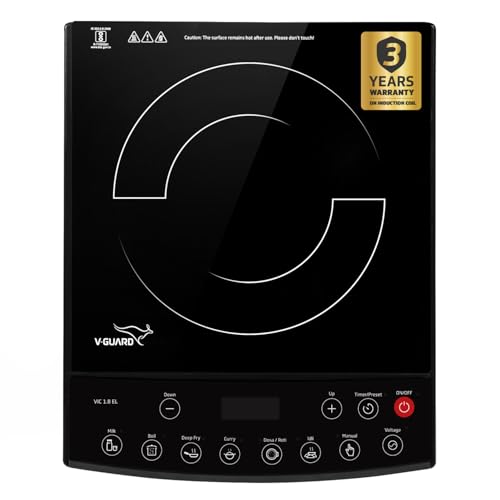
V-Guard VIC 1.8 EL Induction Cooktop | 1800 Watt Electric Induction stove with 7 Power Levels | 3 kV Surge...
 Amazon.in
 - FAST & EVEN COOKING – With a power range of 200 W - 1800 W VIC 1.8 EL ensures fast and even cooking.
- INDIAN COOKING MENUS – It comes with 4 pre-programmed cooking menus like Boil, Dosa/Roti, Idli and Curry along with 2 manual functions like Fry and Manual.
- EFFORTLESS & CONVENIENT COOKING – The 4 hour Timer Function and 24 hour Preset Function makes cooking with VIC 1.8 EL effortless. Its soft switch controls, 4-digit LED display and easy to clean surface ensures convenient cooking.
- COMPACT DESIGN – VIC 1.8 EL comes with a compact design for easy storage and with a 1.2 m long power chord for hassle free usage.
- WARRANTY - 1 year product warranty
V-Guard VIC 1.8 EL Review (2026): The 1800W Engineering Audit


V-Guard VIC 1.8 EL Induction Cooktop | 1800 Watt Electric Induction stove with 7 Power Levels | 3 kV Surge Protection | Temperature Control | Push…
Original price was: ₹5,499.00.₹3,099.00Current price is: ₹3,099.00. -44%
|


Hardware Blueprint & Thermal Dynamics
In the first part of our comprehensive engineering audit. We bypass the marketing brochures to analyze the internal hardware topology, the real-world thermal output, and the exact grid safety protocols integrated into this 1800W machine.

Physical Architecture & Build Integrity
Before evaluating the electromagnetic thermal output, we must look at the physical chassis. The V-Guard VIC 1.8 EL is engineered specifically for the budget segment, prioritizing a slim profile over heavy-duty industrial casing.
Dimensions and Surface Material
Measuring 35.5D x 29.1W x 5.6H Centimeters and weighing a highly portable 2.5 Kilograms, this tabletop unit easily slides beside a primary gas hob.
- The Matte Advantage: The top panel utilizes a black crystal-glass matte finish. In a high-traffic kitchen, standard glossy tempered glass is a magnet for severe scratching and visible grease smears. The A-grade crystalline matte surface employed here is significantly more resistant to the abrasions caused by sliding heavy steel pots, maintaining a cleaner aesthetic over years of use.
- Chassis Dynamics: The unit sits on rubberized anti-skid feet attached to an ABS plastic frame. Because it lacks a heavy metal sub-chassis, high-power cooking (pushing the full 1800W) with lighter, thin-bottomed pans can result in noticeable acoustic vibration, commonly referred to as “pan-rattle,” alongside the standard cooling fan hum.
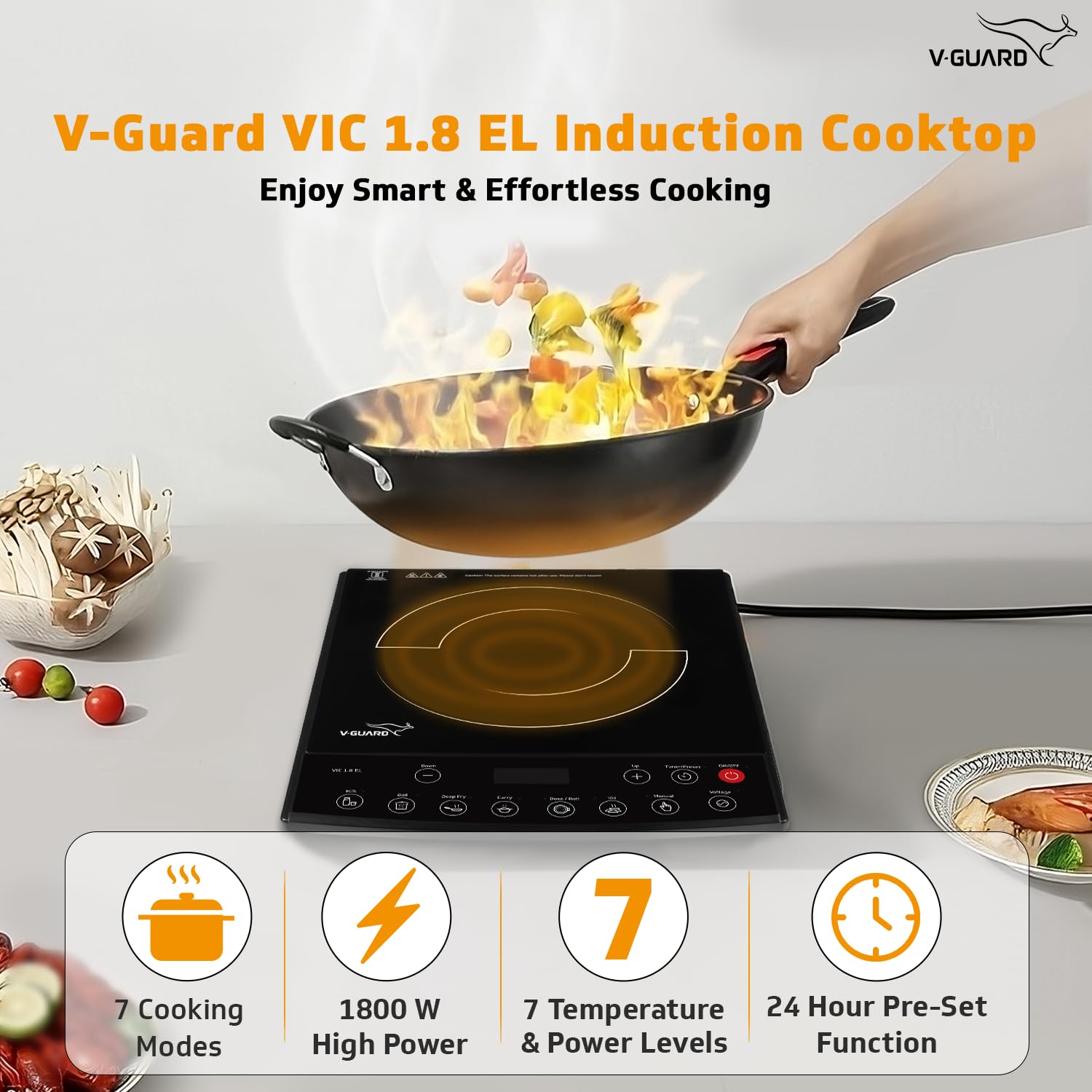
Internal Hardware (Logical Topology)
Opening the ABS frame reveals a cleanly executed, highly standardized power-path chain typical of V-Guard’s engineering methodology.
The Electromagnetic Power Plant
At the core of the VIC 1.8 EL is a single-spiral copper pancake coil with a ferrite underlay. This is the standard delivery mechanism for the 2-kW-class segment, projecting the high-frequency magnetic field directly into the ferrous cookware.
- The IGBT Module: The heavy lifting is done by the Insulated-Gate Bipolar Transistor (IGBT) module. While rated to push a maximum of 1800 Watts, the internal circuitry intelligently caps the current draw to roughly 10 to 12 Amps. This is a critical design choice for older Indian homes, as it keeps the load well within the limits of a standard 230V, 15-Amp wall socket, preventing localized circuit breaker trips.
- The Command Processor: The unit bypasses complex touch-sliders in favor of a highly reliable, basic 8-bit Microcontroller Unit (MCU). This chip handles the 4-digit LED display, mode selection logic, and strict timer protocols.
Power Grid Resilience & Safety Protocols
The Kerala State Electricity Board (KSEB) power grid, especially outside major city centers, is prone to sudden line transients and voltage dips. Plugging a high-wattage induction stove into an unprotected line is a massive hardware risk.
3 kV Surge Protection Integration
This is the standout engineering feature that elevates the VIC 1.8 EL above generic, no-name imports. V-Guard has integrated a dedicated input filter and surge-capacitor rated to absorb a 3 kV surge. While this does not replace a whole-house Surge Protection Device (SPD), it provides a vital buffer against lightning-induced transients and local transformer spikes, drastically reducing the probability of catastrophic motherboard burnout.
Automated Thermal & Voltage Cut-offs
- No-Pan Detection: The MCU actively scans for magnetic resistance. If a non-ferrous pan (like pure aluminum or copper) is placed on the hot zone, or if the unit is turned on while empty, it triggers an immediate soft cut-off to prevent energy waste and coil damage.
- The “Fry” Mode Overheat Reality: The unit features a strict over-temperature cut-off to prevent glass cracking and internal melting. Field Data Note: During continuous, heavy batch cooking of Chapatis or Rotis on the manual “Fry” mode, this thermal sensor can be overly sensitive. The unit will occasionally shut down prematurely to cool itself. While annoying during a heavy cooking session, it is an intended fail-safe, not a hardware defect.

Power Levels, UI, and Indian Cooking Menus
The V-Guard VIC 1.8 EL boasts an 85% energy efficiency rating, delivering rapid heating that fundamentally outpaces traditional LPG burners for liquid-heavy tasks.
Thermal Output & Speed
The power delivery spans from 120W up to 1800W, effectively divided into 7 distinct stepping levels.
During our standardized water-boil stress tests, the 1800W engine successfully brought 1.5 Liters of water to a rolling boil in approximately 4.5 to 5 minutes using an 18cm induction-base stainless steel pan. This speed makes it exceptionally capable for 1-to-2 person households or as an emergency backup.
The Tactile Interface & Presets
V-Guard deliberately ignored the trend of sleek, feather-touch glass panels in favor of tactile push-buttons. For an Indian kitchen where wet fingers, oil splatters, and heavy moisture are constants, mechanical push-buttons drastically reduce input errors and offer superior long-term durability against liquid ingress.
The interface revolves around 6 primary cooking modes:
- 4 Pre-Programmed Indian Menus: Boil, Dosa/Roti, Idli, and Curry. These utilize fixed power and time curves. Instead of constantly adjusting the wattage, you select “Idli,” and the MCU automatically manages the rolling boil required for perfect steaming.
- 2 Manual Modes: Fry and Manual. These allow the user to override the algorithms and manually step the power up or down, paired with a massive 24-hour preset delay function and a 4-hour active cooking timer.

The Kerala Cookware Test: Adapting Traditional Vessels
For an appliance to survive in a Thrissur modular kitchen, it must integrate with our traditional cooking styles. The fundamental rule of the V-Guard VIC 1.8 EL is that it requires a flat, magnetic base. This presents specific challenges for traditional Kerala cookware:
- Meen Chatti (Earthen Clay Pots): Traditional clay pots used for Kerala fish curry are completely non-magnetic and will trigger the “No-Pan” error on the V-Guard. The Workaround: You must purchase an Induction Converter Disk (a flat magnetic steel plate that sits on the glass and heats up the clay pot above it), or switch to a modern, induction-compatible flat-bottomed cast iron Kadai.
- Traditional Uruli (Bronze/Brass): Authentic bronze Urulis will not work directly on this cooktop. You must ensure you purchase an “Induction Base” version, which features a magnetic steel plate fused to the bottom of the vessel.
- Appachatti (Curved Appam Pans): Because the V-Guard has a perfectly flat glass top, traditional round-bottom Appachattis will not make enough surface contact to heat properly and may slip dangerously. Always use a flat-base, induction-ready Appam pan to ensure the electromagnetic field engages correctly.
Market Matrix, Maintenance & The Final Verdict
We move past the raw thermal output and internal logic of the V-Guard VIC 1.8 EL. now, we pit this 1800W machine against its fiercest 2026 rivals in the sub-₹5,000 segment, analyze its long-term hardware degradation patterns, and deliver our blunt retailer verdict.
The 2026 Market Matrix: V-Guard vs. The Competitors
How does the VIC 1.8 EL stack up against the titans of the ₹1,800 to ₹4,500 segment? We benchmarked it against the four most dominant direct competitors currently flooding the Indian market.
The Peer-Group Data Table
| Model | Power Output | Interface Design | Surge & Safety Tech | Real-World Heating Speed (1L Water) | April 2026 Street Price |
| V-Guard VIC 1.8 EL | 1800W | Push Button / Matte Glass | 3 kV Surge + Auto-off | ~4.5 to 5 Minutes | ₹2,300 – ₹2,800 |
| Prestige PIC 20 Neo | 1600W | Push Button / Plain Glass | 4 kV Surge | ~5.5 to 6 Minutes | ₹1,900 – ₹2,200 |
| Bajaj ICX 190FS | 1900W | Feather-Touch / Crystal | Voltage Pro | ~4 to 4.5 Minutes | ₹2,500 – ₹2,800 |
| Pigeon Acer Plus 1800 | 1800W | Feather-Touch / Basic Glass | Basic Surge Handling | ~4.5 to 5 Minutes | ₹1,400 – ₹1,600 |
| Prestige Iris Sleek | 2000W | Full Glass Touch | 4 kV Surge | ~4 to 4.3 Minutes | ₹2,500 – ₹2,900 |
The Engineering Showdown
- Versus the Prestige Lineup: The classic Prestige PIC 20 Neo is slower (1600W) and looks more utilitarian, but it boasts a slightly higher 4 kV surge rating and taps into Prestige’s massive 500+ center service network. The Iris Sleek 2000W outclasses the V-Guard in raw heavy-duty veg-frying power and glass quality but costs more.
- Versus the Bajaj ICX 190FS: The Bajaj is the fiercest competitor here. It offers more power (1900W), a highly responsive feather-touch UI, and crucially, a 2-Year Warranty compared to V-Guard’s 1-year general warranty.
- Versus the Pigeon Acer Plus: The Pigeon matches the V-Guard’s 1800W output for roughly ₹1,000 less. However, our teardown data reveals thinner glass, weaker internal surge handling, and a highly spotty service network in regional Kerala. It is a disposable unit, whereas the V-Guard is a repairable appliance.

Hardware Degradation, Error Codes & Maintenance Protocol
At Gas Care, we analyze how appliances fail over a 5-year timeline. Based on pattern-tearing V-Guard models from our service desk, here are the exact weak points.
The E6 and E8 Error Codes
If you browse user forums, you will see reports of E6 and E8 error codes flashing on the digital display after 8 to 12 months of use.
- The Engineering Reality: These codes almost universally indicate a sensor or logic malfunction, specifically with the internal temperature probe reading incorrect resistance.
- The Resolution: This is why warranty matters. V-Guard backs this unit with a 1-Year General Product Warranty and a robust 3-Year Warranty on the Induction Coil. Because V-Guard is heavily established in Kerala, resolving these specific sensor codes via their service network is swift.
Common User-Induced Failures
- The Wet PCB: While push-buttons are safer than feather-touch panels, they are not waterproof. Heavy spills that seep past the rubberized button membranes will fry the LED display PCB.
- Capacitor Burnout: Even with 3 kV surge protection, running this unit continuously on a highly unstable rural grid with severe under-voltage (brownouts) will eventually stress and blow the power-section capacitors.
The Mandatory Cleaning Protocol
- Thermal Shock Warning: Never wipe the glass surface while the unit is still blisteringly hot or while the internal cooling fan is still running. Applying a cold, wet sponge to hot crystalline glass creates micro-fractures that eventually lead to a catastrophic shattered top. Wait 15 minutes after power-down, then wipe with a mild degreaser.

The Gas Care Cleaning Protocol: Protecting the Matte Glass
The V-Guard VIC 1.8 EL features a black crystal-glass matte finish. While it hides daily smudges better than high-gloss glass, it is highly susceptible to one specific kitchen disaster: boiled-over milk or starchy rice water. When these liquids hit the hot glass around the pan, they instantly carbonize into rock-hard, white crusts.
Never use steel wool, knives, or harsh acidic bathroom cleaners on the matte glass. Follow the Stove-Technica safe restoration protocol:
- The Cool Down: Never wipe the glass while the internal cooling fan is still running. Wait at least 15 minutes for the “Hot” indicator to turn off. Applying cold water to hot crystalline glass can cause fatal micro-fractures.
- The Baking Soda Poultice: For hardened milk or tea stains, do not scrub dry. Create a thick paste using standard baking soda and a few drops of warm water. Apply it directly to the carbonized stain and let it sit for 15 minutes to break down the proteins.
- The Soft Extraction: Use a damp, non-abrasive microfiber cloth to gently buff the paste away in circular motions. The matte glass will return to its factory finish without a single scratch.
- Button Maintenance: Pay special attention to the push-button panel. Wipe it with a slightly damp (not wet) cloth to prevent sticky sugar or starch from seeping past the rubber membranes and shorting out the digital display.
The Final Gas Care Retailer Verdict (2026)
The V-Guard VIC 1.8 EL is a highly competent, well-engineered mid-tier appliance. It does not possess the sheer 2000W brute force of the Prestige Iris Sleek, nor does it have the comprehensive 2-year warranty of the Bajaj ICX 190FS.
Is it categorically better than its peers? No. But it hits a highly specific, reliable sweet spot. You should buy the V-Guard VIC 1.8 EL if:
- You are a 1-to-2 person household or need a dependable electrical backup for your primary LPG gas hob.
- You live in an area prone to grid voltage swings and actively want that targeted 3 kV surge protection.
- You prefer the tactile, fail-proof nature of physical push-buttons over overly sensitive feather-touch glass panels.
- You trust the V-Guard brand infrastructure and their 3-year coil warranty.
You should SKIP this and buy a competitor if:
- You want the safest, longest warranty: Buy the Bajaj ICX 190FS (2-Year warranty + Voltage Pro).
- You want the best long-term rural service: Buy the Prestige PIC 20 Neo.
- You do heavy-duty, daily deep-frying: Buy the Prestige Iris Sleek 2000W.
At a market street price hovering around ₹2,500, the VIC 1.8 EL remains a secure, intelligent investment for the modern Indian modular kitchen.

Gas Care Expert FAQs: Troubleshooting the V-Guard VIC 1.8 EL
When transitioning from an LPG gas stove to a high-wattage induction unit, our technicians frequently field questions regarding error codes, unusual noises, and thermal safety limits. Here are the definitive engineering answers from the Stove-Technica experts:
Q: My V-Guard cooktop keeps shutting off automatically while I am continuously making chapatis or frying snacks. Is the motherboard defective?
A: No, it is not defective; this is the built-in thermal cut-off actively protecting the machine. When you make chapatis on a flat tawa or deep-fry for extended periods on the high-power “Fry” mode, a massive amount of heat reflects directly back down onto the glass surface. Once the internal temperature breaches the safety threshold, the MCU shuts the unit down to prevent the induction coil from melting and the glass from cracking.
- The Gas Care Workaround: Use a heavier, thicker induction-base tawa which absorbs heat better, and step the manual power down to roughly 800W–1000W once the pan is pre-heated, rather than running it at the maximum 1800W continuously.
Q: The digital display is suddenly flashing “E6” or “E8” and the cooktop refuses to heat. How do I fix this?
A: You cannot fix this at home. The E6 and E8 error codes on this specific V-Guard model universally indicate a sensor logic malfunction, meaning the internal temperature probe is reading incorrect resistance or has failed entirely. Because V-Guard provides a 3-year warranty specifically on the induction coil and a 1-year general warranty, you must take the unit to a V-Guard authorized service center for a sensor replacement. Do not attempt to open the chassis yourself, as this voids the warranty.
Q: Why does the cooktop make a loud buzzing sound, and why do my vessels vibrate when I set it to 1800W?
A: This is a combination of electromagnetic physics and chassis design. The VIC 1.8 EL utilizes a lightweight ABS plastic frame rather than heavy metal. When you push 1800 Watts of high-frequency magnetic energy into a lighter, thinner stainless steel pan, the pan physically vibrates against the glass top (known as “pan-rattle”). The buzzing is the sound of the cooling fan and the copper coil humming under maximum load.
- The Solution: Upgrading to heavy-bottomed, multi-ply induction cookware drastically reduces the vibration and acoustic noise.
Q: The box says “3 kV Surge Protection.” Does this mean I can safely use it during heavy Kerala monsoon lightning storms?
A: No appliance is entirely immune to a direct lightning strike. The 3 kV internal surge capacitor acts as a shock absorber for standard KSEB grid transients (sudden spikes when local transformers switch on or off). It protects the delicate IGBT module from these daily micro-surges. However, if you experience severe, continuous brownouts (under-voltage), the power-section capacitors will still degrade over time. Always unplug the unit during severe lightning storms.
Q: The push buttons have stopped responding or feel “sticky”. What caused this?
A: While physical push buttons are generally more durable than feather-touch glass, they have microscopic gaps around the rubber membranes. If boiling milk or starchy water (like rice water) continuously boils over and seeps into these button crevices, it hardens on the internal PCB (Printed Circuit Board), causing the buttons to stick or short out. Always wipe spills immediately before they dry.
People Also Ask (PAA)
Will an 1800W Induction Cooktop increase my KSEB electricity bill significantly?
Induction technology is highly energy-efficient (around 85% efficiency compared to roughly 40% for an LPG gas stove). Because the heat is transferred directly to the metal of the pan rather than the ambient air, it cooks much faster. Operating the V-Guard VIC 1.8 EL at maximum power (1800W) for one full hour consumes exactly 1.8 Units (kWh). At an average domestic rate of ₹5 per unit, boiling water or cooking daily meals will cost roughly ₹9 per hour of active cooking—making it significantly cheaper than current LPG cylinder rates for liquid-heavy boiling tasks.
Can I use my existing aluminum or copper bottom vessels on the V-Guard VIC 1.8 EL?
No. Induction cooktops rely on magnetic fields to generate heat. Pure aluminum, pure copper, brass, and standard glass or ceramic cookware are completely non-magnetic and will not work. The V-Guard’s “Auto-Pan Sensor” will immediately detect the incorrect metal, beep, and shut down. You must use cookware clearly labeled as “Induction Compatible” (typically cast iron, carbon steel, or magnetic stainless steel with a flat bottom).
Is the V-Guard VIC 1.8 EL better than the Prestige PIC 20 Neo?
It depends entirely on your grid stability and power needs. The V-Guard is faster (1800W vs. Prestige’s 1600W) and features physical push buttons with a matte glass finish that resists scratches better. It also boasts a 3-year coil warranty. However, the Prestige PIC 20 Neo offers a slightly higher 4 kV surge protection rating and is backed by Prestige’s massive, industry-leading service network. If you want speed, choose V-Guard. If you live in a remote area and want guaranteed service access, choose Prestige.
What does the ‘Idli’ and ‘Dosa/Roti’ preset actually do?
Instead of forcing you to guess the correct wattage and constantly press the up/down manual buttons, these pre-programmed menus utilize built-in algorithms. The ‘Idli’ setting automatically pushes high heat to bring the water to a rapid boil, then stabilizes to maintain steady steam without boiling dry too quickly. The ‘Dosa/Roti’ setting modulates the heat to maintain the steady, high-temperature flat surface required for batter without tripping the overheat sensor prematurely.
Best Budget Induction Cooktops Under ₹2,000: Tested & Reviewed
Stop wasting money on expensive LPG cylinders for simple boiling tasks. We tested and reviewed the top induction cooktops under ₹2,000 to help you find the perfect, budget-friendly addition to your kitchen.
In-Depth Engineering Review: CELLO Blazing Glaze 1600W Induction Cooktop – The Durable Workhorse
Looking for a safe, reliable budget cooktop? We teardown the CELLO Blazing Glaze 1600W Induction Stove to analyze its thermal power, mechanical durability, and crucial Child Lock feature. See how it stacks up against the best in India.
Top 5 High-Wattage Induction Stoves (2000W+) for Fast Indian Cooking
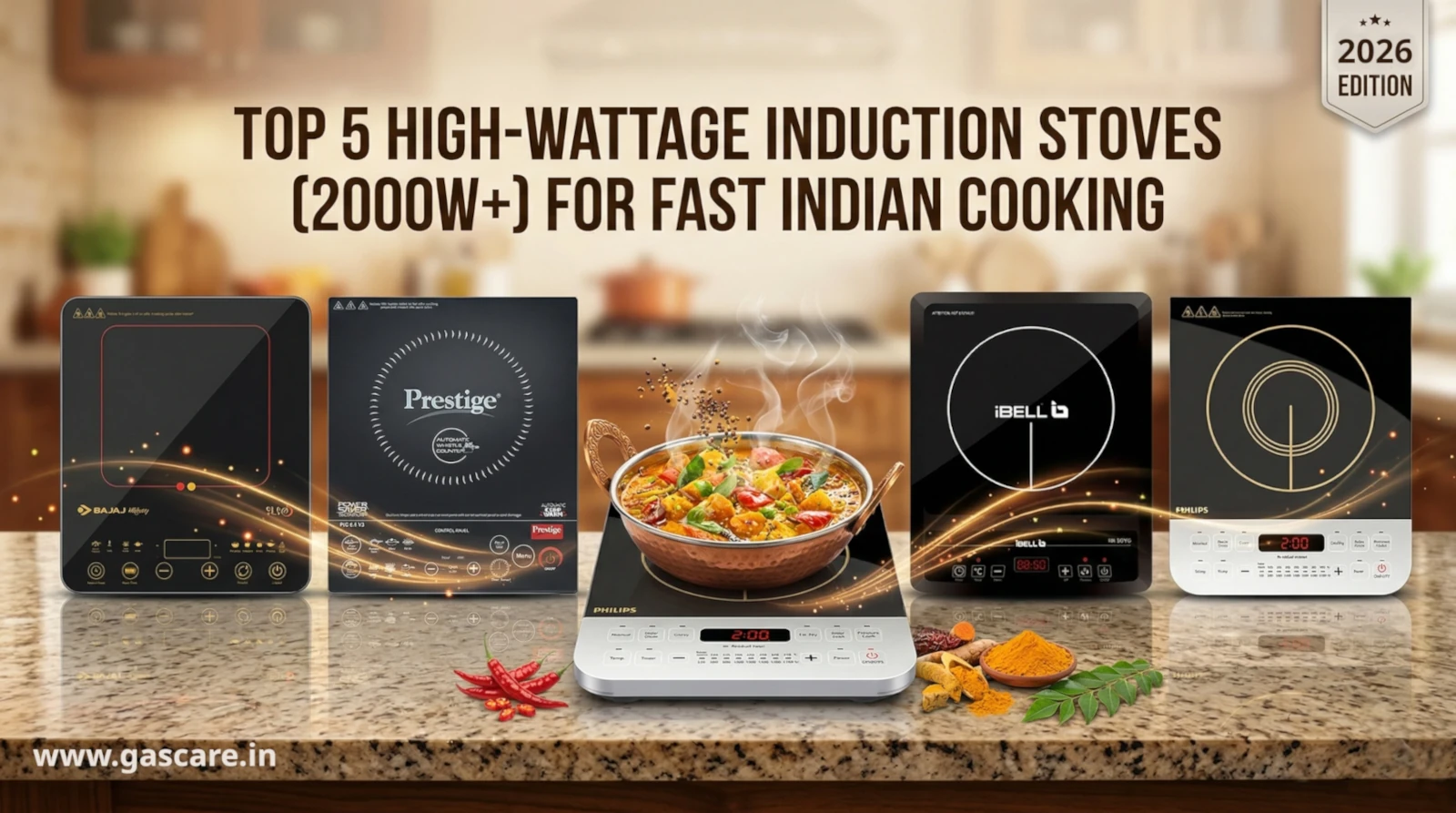
Struggling to deep-fry or pressure-cook on a basic 1200W electric stove? Discover the top 5 high-wattage (2000W+) induction cooktops in India for 2026. Get genuine gas-like speed with our expert reviews of heavy-duty models from Prestige, Philips, Bajaj, and more. Stop waiting and start cooking!
Pigeon Cruise 1800W Induction Cooktop Review: The Ultimate Budget Pick?
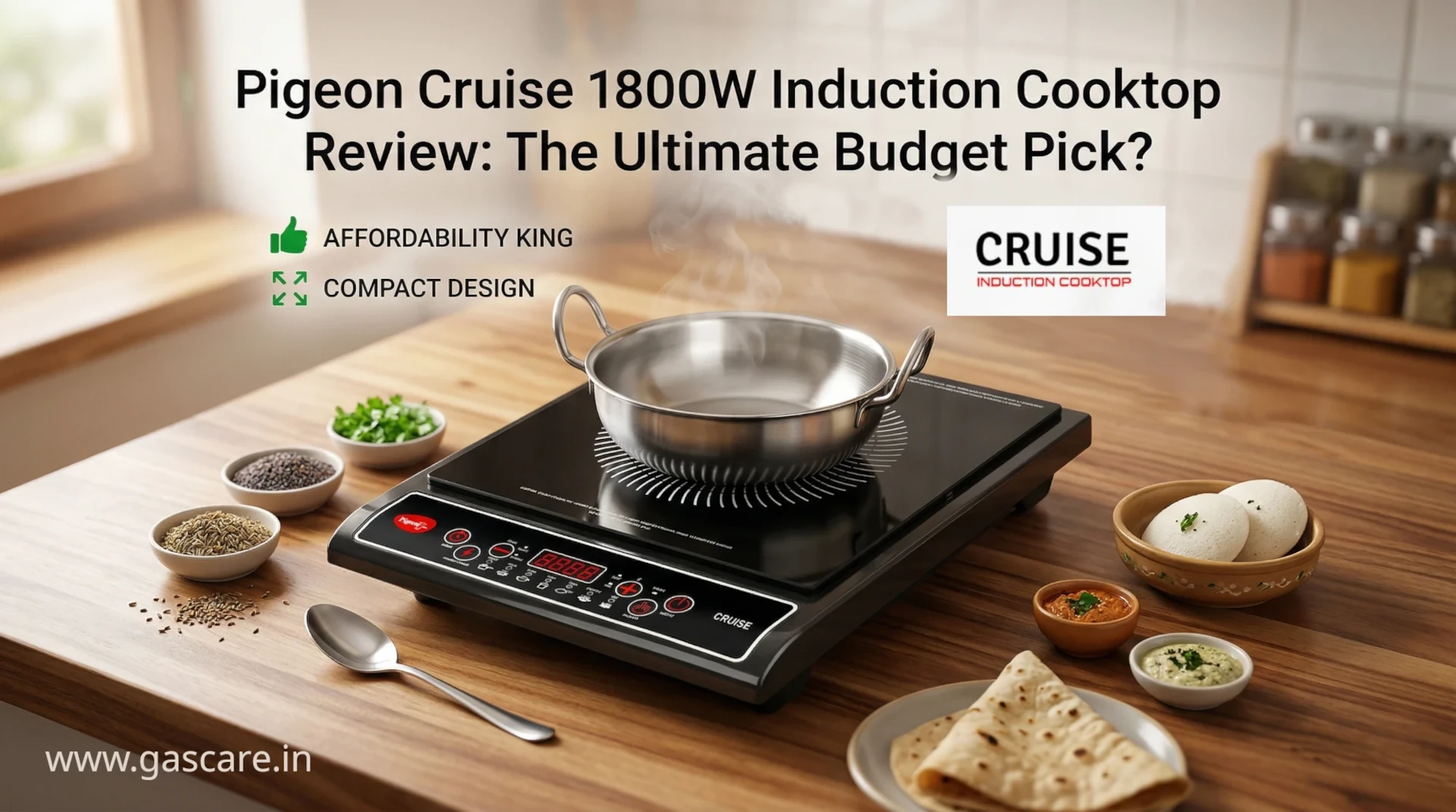
Is the Pigeon Cruise 1800W the right budget induction for your kitchen? We break down its cooking features, real-life performance, and known service issues to help you decide if it’s a smart buy or a risky investment.
Expert Review: Bosch PIB375FB1E 30cm Domino Induction Hob – The Ultimate Space-Saving Luxury?
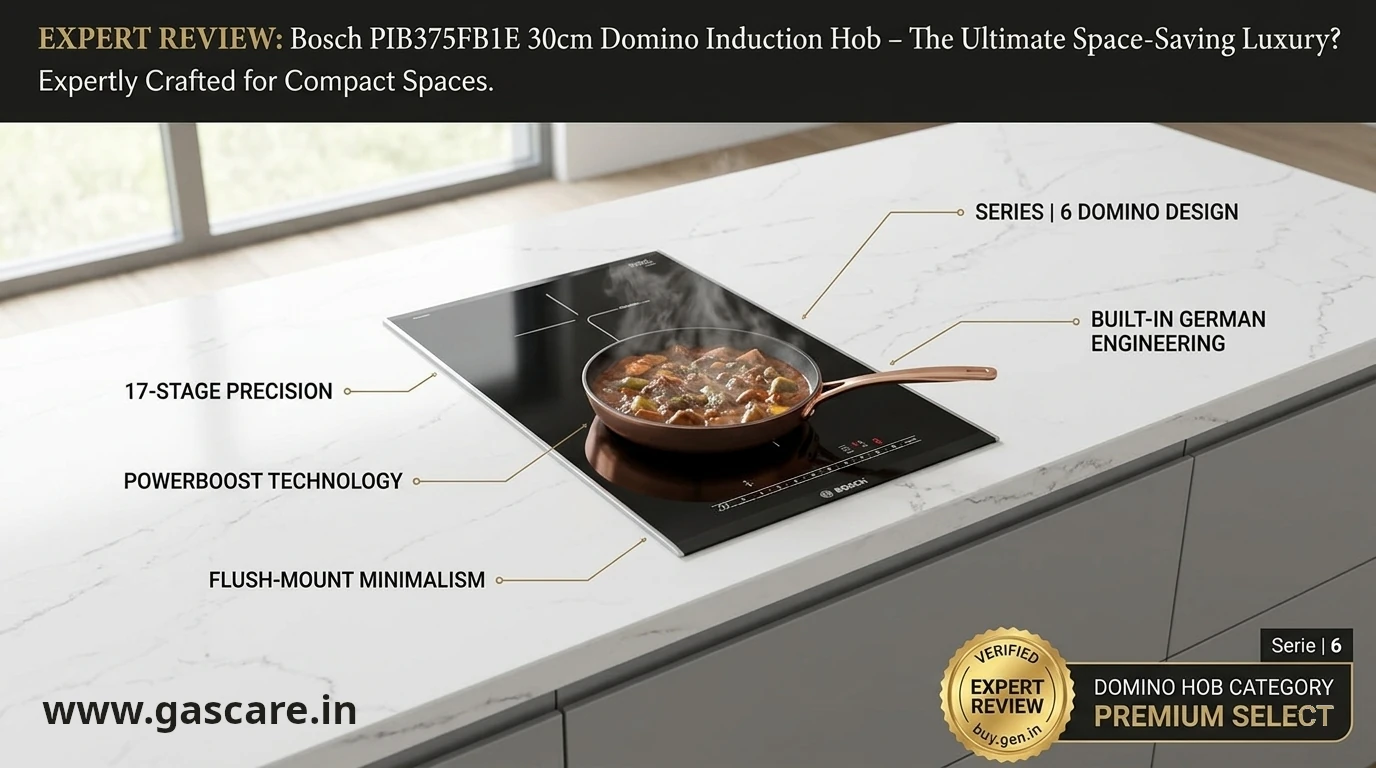
Short on counter space but demand premium performance? We review the heavy-duty 3.7kW Bosch PIB375FB1E Domino Hob. Discover the exact installation dimensions, hidden wiring costs, and whether this 30cm German powerhouse is right for your hybrid kitchen.
Expert Review: Hawkins Futura 2000W Single Induction Hob (FIC1A1) – Gas-Like Precision on a Glass Top?
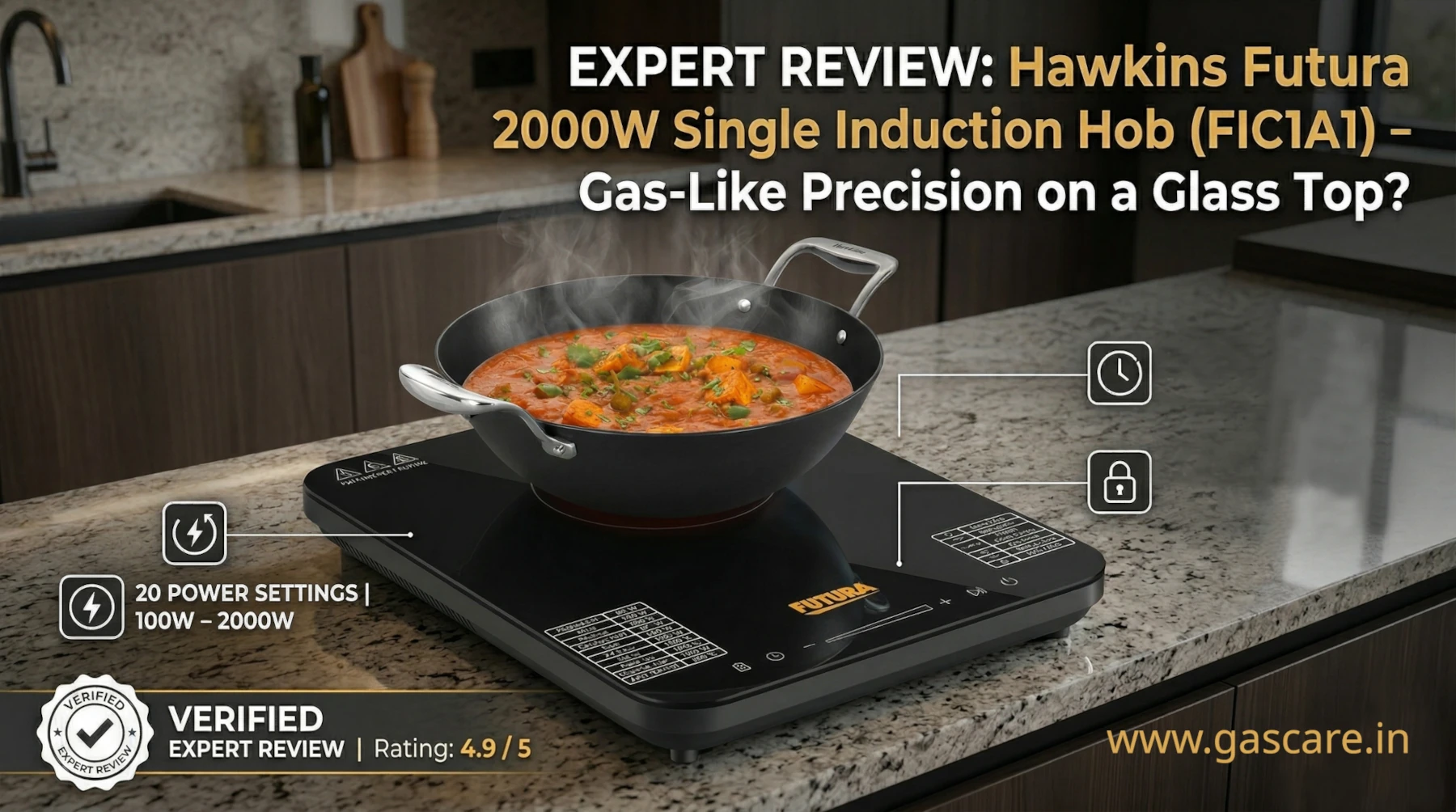
Discover if the Hawkins Futura 2000W Induction Hob (FIC1A1) is the ultimate electric upgrade for your kitchen. We review its unique 20-level power control, Indian cooking presets, and overall energy efficiency to see if it truly mimics a traditional gas flame.
The Ultimate Philips HD4938/01 Induction Cooktop Guide: Presets, Errors & Cookware Explained
Unlock the full potential of your Philips HD4938/01 Induction Cooktop. From mastering the 10 Indian cooking presets to troubleshooting error codes and choosing the perfect magnetic cookware, this comprehensive guide has everything you need to cook faster, safer, and smarter.
The 2026 Engineering Audit: PHILIPS Viva Collection HD4938/01 Induction Cooktop Review
Upgrading to a high-speed electric cooktop? Our in-depth teardown of the Philips Viva Collection HD4938/01 2100W Induction Cooktop evaluates its seamless micro-crystal glass design, strict voltage safety sensors, and real-world boiling speeds for the modern Indian kitchen.
V-Guard: Today’s Top Deals
V-Guard VIC 1.8 EL Induction Cooktop | 1800 Watt Electric Induction stove with 7 Power Levels | 3 kV Surge Protection | Temperature Control | Push…

V-Guard VRCD 1.8 Litre Electric Rice Cooker, 5 Year Heating Plate & 2 Year Product Warranty, Automatic Cooking with Warm & Cook Functions, Pale Orange

V-Guard VRC 1.0 C 1-Litre Electric Rice Cooker Small with 400 W Power (New Launch) | 2 Pots, Spatula, Rice Separator | 2-Year Product & 5-Year…

V-Guard VHD 360 AGR Kitchen Gas Hobtop 3 Burner with Auto Ignition/Brass Burners/Heat Resistant Toughened Black Glass/Matt-finish Pan Support /…
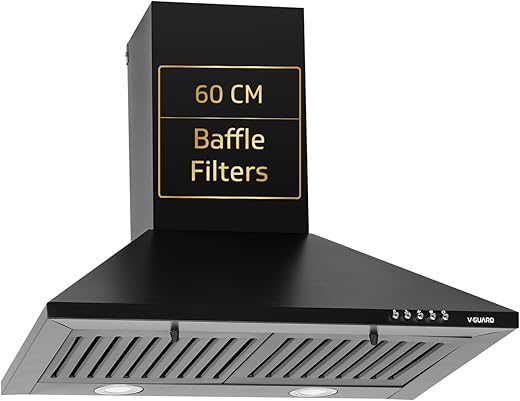
V-Guard M10 Pro Chimney for Kitchen| High Suction Power of 900 m3/h | Push-Button Controls | Baffle Filter | Free Cleaning Contract

V-Guard VHD 480 ZBS Kitchen Gas Hobtop 4 Burner with Auto Ignition/Triple Ring Brass Burners/Heat Resistant Toughened Black Glass/Dome Cast Iron…